

Undergraduate internships
Undergraduate Internship Program and Application Information
Application Intake Status: AY 2026-27 Closed
Application deadline date: May 3, 2026
General Information
The ASU/NASA Space Grant Internship Program supports approximately 30 to 40 undergraduate students to perform NASA-related research. This program enhances undergraduate education by providing hands-on research opportunities and educational outreach with ASU researchers. Interns earn a stipend of $1700 per semester ($3400 for the academic year) while gaining valuable research experience in their field.
NASA Space Grant seeks applications from all science, technology, engineering, and mathematics (STEM) fields. We encourage applications from a broad range of disciplinary and personal backgrounds to help build a strong future workforce in NASA related fields. Note: This internship program is designed for students attending classes on campus.
Informal Education and Outreach
ASU Space Grant awardees are required to complete a combined 20 unpaid hours of informal education and professional development separate from the research project. Awardees are expected to perform 15 hours of volunteer activities Fall semester and 5 hours Spring semester. They are typically performed at public education events i.e. Astronomy Night, Star Gazing, Homecoming Block Party, Earth and Space Open House.

Maximum Credit Hours
Students must be enrolled full-time to be considered for a Space Grant internship. While there is no maximum number of academic credit hours that Space Grant interns can take, we recommend taking no more than 15 credit hours during the time of award. Participation in this program is challenging and will require effective time management.
Mentor and Available Research Opportunities
Mentors and project selection can occur in a few ways:
- The student applicant may be aware of a project that a faculty member is working on and they ask them if there is a possible internship opportunity to help with the project
- A faculty member has a project that they want a specific student to work on
- A faculty member posts a project on the ASU/NASA Space Grant website for students to select a project of interest (feature under development)

Mentor Selection
Applicants are strongly encouraged to identify a faculty mentor before submitting an application. Potential mentors can be identified by reviewing faculty research interests and projects. Once a potential mentor and/or a research topic has been identified, the applicant should respectfully approach potential mentor(s) and ask if they have research projects for undergraduates and if they would serve as your mentor in the Space Grant Program. This must be a mutually agreed upon collaboration. Current and potential mentors must submit an application and request the student as a prospective intern.
Available Research Opportunities
The foundation of an ASU/NASA Space Grant internship is the matching of interns with faculty members and a project. There is a high success rate when there is a balance between the faculty member’s current research and the intern’s passion for the topic.
With all Space Grant internships, there must be a pairing between intern, mentor and project. If you are looking to participate in the program but missing one of these three components, please read below for ways to complete your intern, mentor and/or project selection.
Students Applicants
If you are aware of a faculty member’s current or new research project, contact them directly to inquire about working with them on their project as a NASA Space Grant intern. Note that not all faculty have funding or positions available for their research. If you don’t ask, you don’t know.
If you have already had a conversation about a project, complete the application and enter the faculty member and project information for your matching.
Application Review Process
The Space Grant Steering Committee reviews internship and mentor applications and makes awards during the summer break. If a student application is submitted and awarded without identifying a faculty mentor, the Steering Committee will try to provide a mentor. While it is acceptable to apply without identifying a mentor, for maximum consideration, prospective interns should identify a mentor and a project in the application. Projects and students are evaluated for alignment with NASA’s Mission Directorates (MD) and overall program balance.
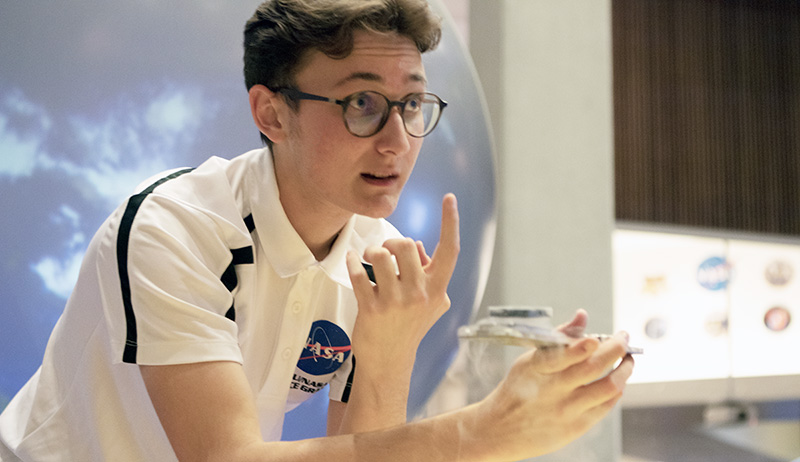
Awardee Requirements
Students awarded an internship are required to participate in four mandatory activities during the academic year.
- Complete 20 hours of (unpaid) outreach and informal education activities: 15 hours fall semester and 5 hours spring semester. Examples of informal education activities can be found here
- Attend the ASU/NASA Space Grant Alumni Night in January
- Present initial research results at the annual ASU/NASA Space Grant Poster Session typically held in February.
- Present research results at the annual Arizona Space Grant Consortium Undergraduate Research Symposium in April.
- NASA Requirement: Complete a NASA Gateway profile (only once for the lifetime of serving as a mentor)
- NASA Requirement: Complete a brief Space Grant Program evaluation in the beginning, middle and end of the academic year.
Multiple Awards
Students are encouraged to apply for various research internships. Please be aware that Space Grant will not support a research project that is concurrently supported by another scholarship/internship funding source. Questions or clarification on this policy can be addressed to Desiree D. Crawl at [email protected]
The application for the 2026-27 academic year internship is now closed. The application for 2027-28 will open Spring 2027.

The Space Grant program has and continues to provide me with a streamlined way to get professionally involved in my field. The outreach opportunities, mentor process, and integration with my schooling has made it an invaluable experience for myself and I feel it’s better prepared me for whatever’s beyond undergrad school.
Alex Blanche BS Astrophysics | School of Earth and Space Exploration ASU/NASA Space Grant Intern